

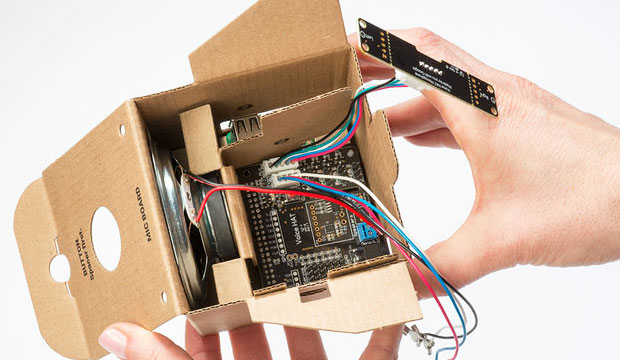
Google and AIY Projects last week launched an open source do-it-yourself artificial intelligence Voice Kit for Raspberry Pi hobbyists.
The AIY Voice Kit includes hardware for audio capture and playback, connectors for the dual mike daughterboard and speaker, GPIO pins to connect low-voltage components such as micro servos and sensors, and an optional barrel connector for a dedicated power supply.
The Voice Kit can use cloud services such as the recently released Google Assistant SDK, which is enabled by default, or it can use the Cloud Speech API or run completely on-device.
The kit was designed and tested with the Raspberry Pi 3 Model B.
No Limits
Billy Rutledge, director of AIY Projects, said developers can run Android Things on the Voice Kit with full functionality. This makes it easy to prototype IoT devices and scale them to full commercial products with various turnkey hardware solutions, including the Raspberry Pi 3, the Intel Edison, and the NXP Pico.
The Voice Kit can replace physical buttons and digital displays on household appliances and consumer electronics, replace smartphone apps to control connected devices, and add voice recognition to assistive robotics, for example.
According to Michael Jude, a program manager at Stratecast/Frost & Sullivan, applications for the kit are unlimited.
"If the IoT is going to take off, it has to be easy to use," he told LinuxInsider. "A voice interface achieves this by making intelligent devices able to interact naturally with humans."
AIY has published a parts list, assembly instructions, source code, and suggested extensions.
The kit began shipping to subscribers of The MagPi Magazine earlier this month.
It's also available at more than 500 Barnes & Nobles stores in the United States and at UK retailers WH Smith, Tesco, Sainsburys, and Asda.
The Voice Kit's Limitations
"It's a great teaching and development tool, but we need to understand its limitations," observed Jim McGregor, principal analyst at Tirias Research.
"With limited processing performance, you will only be able to perform certain functions on the device," he told LinuxInsider. "Don't expect it to be able to replace Alexa or Siri."
McGregor suggested that the Voice Kit might complement Google Home or Google Voice "by providing the electronics designer a platform to develop certain functions on before porting that model to a device. "
"I wouldn't use it for production," said Rob Enderle, principal analyst at the Enderle Group.
It's "too expensive," he told LinuxInsider, "but short of that, it could be very useful."
Google's AI Strategy
"In 20 years, just about every new piece of electronics you come in contact with will be using some form of AI," Tirias' McGregor predicted. "Google's looking to establish market share as the segment grows, and to find opportunities for new business models around AI, which is wise."
There are very few experts in AI today, and platforms like the Voice Kit "will help the next generation of engineers develop the expertise the industry needs," he added.
The AIY Voice Kit represents Google's first collaboration on a hobbyist project.
There are three reasons Google might find that market attractive, suggested Enderle:
- The technology will get into the educational field "and will help drive kids to become engineers, which Google desperately needs";
- It will get more people comfortable with AI technology, "thus helping create both a market and the people who can service it"; and
- It will help create more products that will build out the Google Home ecosystem.
"Natural language processing is the future of consumer electronics," Frost's Jude said. "By getting the maker community interested in this technology, consumers will be introduced to voice interfaces more quickly."




















 Loading ...
So what IS the cost of the kit???